
TLDR: Enterprise teams deploying translation on mobile and embedded devices face limited SDK options. Google ML Kit and Apple Translation have platform restrictions and branding requirements. Open-source models (Helsinki-NLP, T5, mBART, NLLB, madlad400) offer cross-platform flexibility but require quantization for on-device deployment. This guide covers model selection, licensing, quantization strategies, and inference frameworks for AI-powered translation.
Table of Contents
- Where to implement translation models: On-device vs. Cloud
- Popular Open-Source Translation Models: Which Translation Model to Choose
- How to Deploy Translation Models on Mobile and Embedded Devices
- Get Started with On-device Translation
- Frequently Asked Questions
Where to implement translation models: On-device vs. Cloud
Enterprise teams face a critical decision when implementing translation capabilities: rely on cloud APIs or deploy models locally on mobile and embedded devices. While cloud services like Google Translate and DeepL offer convenience, they introduce latency, ongoing costs, and data privacy concerns that can be dealbreakers for many enterprise applications. On-device AI addresses these inherent limitations of cloud-based APIs. However, commercially maintained on-device translation SDK options remain limited:
Google ML Kit Translation API: Only runs on iOS and Android devices and cannot be used on embedded devices such as cars, TVs, appliances, or speakers without Google's permission, and when used on personal computing devices, Google attribution, such as powered by Google Translate, and Google Play Services are required, limiting enterprises' options and branding capabilities.
Apple Translation: CoreML models are available via the Swift Translation API for third-party App Store apps. Apple Translation does not support other platforms.
Enterprises requiring cross-platform support or brand control face two options: build or open-source. Building from scratch requires massive datasets and deep learning expertise, with initial development costs ranging from $5-50M plus ongoing maintenance. Open-source translation offers a more viable path for cross-platform applications.
This guide walks through the technical implementation of open-source neural machine translation models for mobile and embedded systems, covering model selection, quantization strategies, and inference frameworks.
Popular Open-Source Translation Models: Which Translation Model to Choose
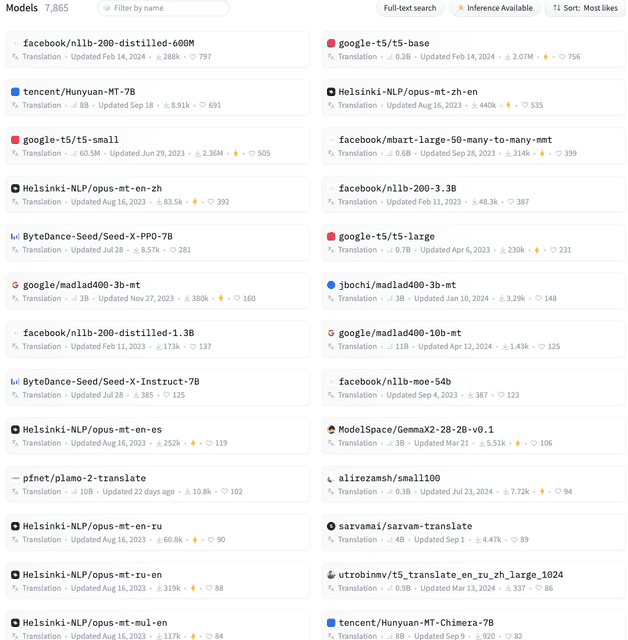
The landscape of open-source translation models has matured significantly; there are almost 8,000 translation models on Hugging Face. Each translation model offers different trade-offs in terms of language coverage, quality, size, ease of integration, and licensing.
1. Meta NLLB (No Language Left Behind)
Meta's NLLB (No Language Left Behind) series represents one of the most comprehensive multilingual translation efforts, supporting 200+ languages, including many low-resource languages previously underserved by machine translation.
Meta's NLLB family spans from 54.5 billion to 600 million parameters. The smallest variant, NLLB-200-distilled-600M, ranks as Hugging Face's most popular translation model. However, with a 2.5GB model size, it still remains too large for typical mobile deployment.
Critical limitation: CC-BY-NC 4.0 license prohibits commercial deployment of NLLB models.
Use case: Research, non-commercial applications requiring broad language support.
2. Google T5
Google's T5 (Text-to-Text Transfer Transformer) takes a unified approach to natural language processing, treating all tasks, including translation, as text-to-text transformations. This architectural decision, rooted in the transformer model framework, provides flexibility to perform multiple tasks, beyond pure translation.
t5-small (60.5M parameters) offers the most accessible entry point for mobile deployment. Fast loading times and low memory consumption come at the cost of accuracy compared to larger family members.
t5-base (220M parameters) represents the sweet spot for many enterprise applications with its ~900MB model size. Significantly better translation than t5-small while remaining deployable on mid-range and flagship mobile devices.
t5-large (770M parameters) delivers the highest quality in the T5 family, approaching cloud service accuracy for high-resource language pairs. Its 3 GB model size limits deployment on mobile devices and embedded systems, but similar to NLLB-200-distilled-600M, applications where accuracy justifies the resource investment, such as medical device translation or financial services, can benefit from t5-large's accuracy improvements.
Implementation note: T5's text-to-text architecture requires task-specific prompting like "translate English to Spanish:" before providing text. This could be advantageous for apps, justifying the model's memory footprint across multiple capabilities (summarization, question answering).
License: Apache 2.0, which is one of the most permissive open-source licenses. The only requirement is preserving the license text and copyright notices in distributions. No attribution required in end-user interfaces.
3. Helsinki-NLP Opus-MT Series
The Helsinki-NLP team's Opus-MT translation models are optimized for individual translation directions, rather than providing a single translation model. The Opus-MT model family has hundreds of models, each covering specific pairs:
- English-to-French (
opus-mt-en-fr) - Chinese-to-English (
opus-mt-zh-en) - German-to-English (
opus-mt-de-en)
Language family pairings like opus-mt-ROMANCE-en (translating Romance languages—Spanish, French, Italian, Portuguese… —to English), bring the Opus-MT collection to over 1,500 models.
Quality advantage: Focused models often deliver superior quality for their specific translation directions compared to multilingual alternatives despite smaller model sizes. Specialization allows each model to dedicate full capacity to the nuances of a single language pair.
Enterprise use case example: A U.S. company can deploy bidirectional Spanish-English translation using two 300MB models (opus-mt-es-en and opus-mt-en-es) and achieve better accuracy than larger multilingual models. Smaller size results in faster inference, lower memory consumption, and better battery life on mobile devices.
Practical limitation: Language coverage - supporting 20 language pairs requires 40 separate models, consuming more storage than a single multilingual model. Many enterprises adopt a hybrid strategy: deploy Opus-MT models for high-traffic language pairs while maintaining a multilingual model (e.g., t5-base) for rare combinations.
License: Pre-trained Opus-MT models are released under the CC-BY 4.0 license. CC-BY 4.0 permits unrestricted commercial use as long as the original work is properly attributed. So Enterprises can deploy Opus-MT in commercial applications without facing licensing fees or revenue-sharing requirements.
4. Meta mBART-large-50-many-to-many-mmt
Meta's mBART (Multilingual Bidirectional and Auto-Regressive Transformers) represents an earlier generation of multilingual translation models that remains highly relevant for enterprise deployment. The mBART-large-50-many-to-many-mmt variant supports 50 languages with truly many-to-many translation capability. It can translate between any pair of its supported languages without requiring English as an intermediate due to its architecture emphasizing language-independent semantic representations and enabling zero-shot translation between language pairs not seen during training. For example, if it were trained on English↔Spanish and English↔French pairs, it would be able to do Spanish↔French, despite not being trained on it. This approach enables stronger cross-lingual transfer, and rare language pairs benefit from training on related languages, more consistent translation quality across its supported languages, and efficient many-to-many translation without requiring separate translation models or routing logic.
Size Consideration: At 610M parameters, mBART sits between NLLB-600M and NLLB-1.3B in size, offering a middle ground in the quality-versus-resources trade-off.
License: License for mBART-large-50-many-to-many-mmt is uncertain. There is no mention on its HuggingFace page. Although mBART is a part of Fairseq(-py) toolkit, which is released under the MIT license, we recommend enterprises reach out to the Facebook Research team before any commercial deployment, as NLLB translation models under the same repository are subject to CC-BY-NC 4.0, which doesn't permit commercial deployment.
5. Google madlad400-3b-mt
MADLAD-400, represents an ambitious multilingual translation effort, supporting 400+ languages. This breadth comes at a cost. madlad400-3b-mt with a 12GB model size makes direct mobile deployment impractical.
The model's true differentiator is its long-tail language coverage, including many regional languages, dialects, and low-resource languages that have minimal translation support elsewhere.
madlad-400's architecture allows aggressive quantization, making it deployable on modern mobile devices and embedded systems. For example, GGUF 2-bit quantization can reduce the model to under 1GB, enabling mobile deployment for applications where significant accuracy loss is acceptable.
Performance variance: High-resource languages (English, Spanish, Chinese, French) perform better than low-resource languages. The main value proposition of madlad400-3b-mt is the breadth rather than best-in-class quality for specific pairs. Hence, enterprises should carefully assess whether 400-language support justifies the additional resources.
License: Apache 2.0. madlad400-3b-mt, similar to Google's other model, t5 allows unrestricted commercial use rights. Attribution is not required in end-user interfaces. The permissive licensing combined with exceptional language coverage makes madlad400 ideal for global enterprises requiring comprehensive language support without legal complexity.
How to Deploy Translation Models on Mobile and Embedded Devices
Deploying translation models on mobile and embedded devices requires careful optimization to balance quality, speed, and resource constraints. Modern mobile devices typically offer 8GB+ RAM with increasingly capable ARM processors and specialized neural processing units, while embedded systems operate under tighter constraints.
Language Model Quantization Methods for On-device Translation
Enterprises deploying translation models on mobile and embedded devices must start with quantization, which reduces model size and computational requirements while maintaining acceptable quality. However, LLM quantization is surprisingly nuanced. (We learned the hard way while developing picoLLM Compression.) There are many decisions enterprises need to make.
Step 1: Select a quantization method
Popular quantization methods include:
- GPTQ - Post-training quantization for GPT-family models
- LLM.INT8 - 8-bit quantization maintaining full precision
- AWQ - Activation-aware weight quantization
- SqueezeLLM - Dense-and-sparse quantization
- GGML/GGUF - Community-developed, widely adopted format
Critical insight: Even using identical quantization techniques on the same model, developers may produce different results. There are over 23,000 Llama models quantized using GGUF on Hugging Face, almost 1,000 models for each variant.
Step 2: Select an Inference (Runtime) Engine
Choosing the right inference framework significantly impacts deployment success. Each option presents different trade-offs in platform support, performance, and ease of integration.
- TensorFlow Lite serves as the workhorse for Android-focused deployments, offering mature tooling, great documentation, and broad hardware support. The framework handles both INT8 and FP16 quantization well, with extensive translation model conversion tools. The primary downside is a larger runtime, introducing a serious runtime overhead.
- ONNX Runtime delivers cross-platform consistency with a small runtime footprint and growing quantization support. The framework makes it easy to convert translation models from PyTorch or TensorFlow to run across more platforms - iOS, Android, and embedded Linux. However, ONNX is not as optimized as platform-specific ones.
- ExecuTorch, Meta's newer framework designed specifically for mobile and edge deployment, offers a small runtime footprint. The framework requires PyTorch as the model source. Its relative newness means a smaller ecosystem compared to others, such as TensorFlow Lite.
- llama.cpp is good at CPU inference and a great fit for systems without GPU acceleration. While originally focused on large language models, the ecosystem increasingly supports translation models through conversion tools and community contributions.
Models and runtimes initially built for server deployment still struggle compared to the native solutions, like CoreML and picoLLM.
- CoreML provides excellent performance on iOS and macOS by automatically leveraging Apple's Neural Engine and Metal GPU acceleration. Apps exclusively targeting Apple's ecosystem benefit from Core ML's deep integration. However, models converted to Core ML from other frameworks aren't as efficient as Apple Translation.
- picoLLM is a proprietary inference engine developed by Picovoice to run X-bit quantized language models, compressed by picoLLM Compression. It's a great fit for enterprise applications, as it's more efficient than repurposed runtimes, allowing models to run across platforms with no accuracy compromises. However, since it's a proprietary algorithm, researchers cannot use or reverse engineer it to build their own solutions.
The typical conversion pipeline starts with a PyTorch or Hugging Face model, exports to ONNX format, applies quantization (INT8, GGUF, or others), converts to the target framework, and optimizes for specific hardware. Modern tooling automates much of this process, though validating quality at each step remains critical.
Get Started with On-device Translation
Implementation Roadmap
Enterprise teams ready to implement on-device translation should follow a phased approach:
Phase 1: Assessment
Begin with a clear assessment of translation volume, required languages, accuracy thresholds, device constraints, and compliance requirements.
Phase 2: Proof of Concept
Benchmark two to three candidate translation models on representative content, test quantization strategies, and confirm performance on target devices.
Phase 3: Production Implementation
Integrate the chosen inference framework, build caching and optimization logic, monitor via LLMOps tools, and conduct a security review before deploying to production.
If you do not have the in-house on-device or machine learning expertise to deploy open-source translation models on mobile and embedded platforms, contact sales and work with on-device AI experts to get it right.
Contact SalesFrequently Asked Questions
No. NLLB models use the CC-BY-NC 4.0 license, which prohibits commercial use. Consider Google's T5 and madlad400 or Helsinki-NLP's Opus-MT models instead.
Among the ones discussed in this article, Helsinki-NLP Opus-MT models for individual language pairs and T5-small for multilingual translation are the smallest models.
Not necessarily. Multilingual models (T5, mBART, madlad400) handle multiple pairs with one model, while Opus-MT requires separate models per direction.
It depends on the quantization method and techniques used. INT8 quantization typically achieves a 4x reduction, while GGUF Q4 can reach 8x. However, quantization affects the quality (accuracy) of models, which depends on several factors, such as quantization method, quantization level, model, etc. For example, at sub-4-bit, GPTQ reduces the accuracy of famous open-weight models, while picoLLM recovers the lost accuracy by up to 100%.
Not necessarily. Modern translation models run efficiently on CPU-only devices through quantization and optimized inference frameworks like picoLLM, TensorFlow Lite or ONNX Runtime. GPU acceleration improves performance but isn't required for acceptable latency on modern mobile processors.


