
Speaker Recognition is the technology that is used to identify and verify speakers based on their distinguishable voice characteristics.
Microsoft initially released Azure AI Speaker Recognition as a limited access feature, available to select enterprises. Subsequently, they paused new registrations for the program and announced its retirement, effective September 30, 2025. This retirement has prompted developers to seek alternatives, as their products will no longer be able to access the Azure AI Speaker Recognition API. This guide is prepared for enterprises seeking alternatives to Azure AI Speaker Recognition and metrics for comparison.
Azure AI Speaker Recognition Alternatives
pyannote Speaker identification
pyannote was started as a Speaker Diarization research project by Hervé Bredin. Later, he commercialized the product and founded a SaaS company, pyannoteAI. One of the offerings of pyannoteAI is Speaker Identification which combines pyannote's speaker diarization technology and voiceprints.
pyannote Open-source vs. pyannoteAI Closed-source
Open-source pyannote, written in Python using PyTorch, supports Python 3.8+ on Linux and macOS. This limits cross-platform deployment. pyannoteAI's cloud API addresses this by operating via remote servers. Open-source pyannote's pre-trained models, trained on VoxCeleb, often require retraining for real-world scenarios like phone calls or meetings. pyannoteAI's cloud API offers enhanced options and enterprise-grade support. However, it involves sending voice data to third-party servers, so enterprises should consider the risks of cloud computing, such as latency, privacy, and security.
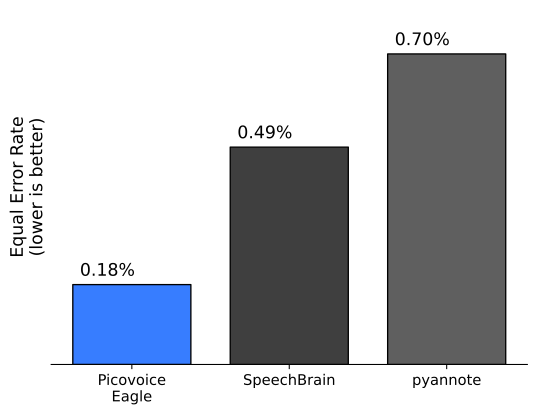
Compare the Equal Error Rate of Eagle Speaker Recognition, Speech Brain, pyannote (open-source).
SpeechBrain
SpeechBrain is a general-purpose speech toolkit with speaker recognition. It uses ECAPA-TDNN, ResNET, Xvectors, PLDA, and Score Normalization. Like open-source pyannote, SpeechBrain supports Python 3.7+ on Linux and macOS. As an open-source project, it relies on a GitHub community for support.
Amazon Connect Voice ID
Voice ID is an Amazon Connect feature, that uses machine learning to provide real-time caller authentication and fraud risk detection to make voice interactions faster and more secure. Voice ID is available as a part of the Amazon Connect offering.
Google Cloud SpeakerID
Speaker ID is available to paying Dialogflow CX customers as a part of the Dialogflow offering. Enrollment to this SpeakerID is free, pricing is based on verification per request. In Active mode, a user repeats a random phrase from a list of several phrases.
Picovoice Eagle Speaker Recognition
Eagle Speaker Recognition is Picovoice's proprietary engine. Its efficiency enables cross-platform operation. Eagle is private, compliant with regulations (GDPR, HIPAA, CCPA), and reliable due to local processing. It is language-agnostic (works independently of language) and text-independent (doesn't require specific phrases), with simple enrollment. It only takes a few lines of code to evaluate Eagle's out-of-box capabilities.
Best Speaker Recognition Engine
The best speaker recognition engine can vary from one enterprise to another. For an enterprise working on a skunk project with no budget but the availability of technical resources, open-source engines may fit better. An enterprise that has already been using Amazon Connect, may find VoiceID is the best solution for its voice biometrics needs. After defining the needs and requirements enterprises should consider various factors before choosing Speaker Recognition for their products and services. Some of them are:
- Performance
- Learn more about Speaker Recognition Evaluation Terminology, such as False Acceptance Rate, False Rejection Rate, Equal Error Rate, and Detection Error Trade-off to make data-driven decisions!
- Platform Support
- Compliance
- Language Dependency
- Read more on Language-Independent Speaker Recognition
- Text Dependency
- Explore the differences between text-dependent and text-independent Speaker Recognition solutions
- Developer-Friendliness
- Availability of Support
- Total Cost of Ownership
Best Practices for Migrating from Azure AI Speaker Recognition
- Start evaluating alternative solutions as early as possible
- Allow sufficient time for fine-tuning and customizing the new Speaker Recognition solution for your application
- Inform users about transitioning enrolled profiles and how their voice profiles will be stored
If you're not sure how to migrate from Azure AI Speaker Recognition, work with an expert!
Talk to Sales


